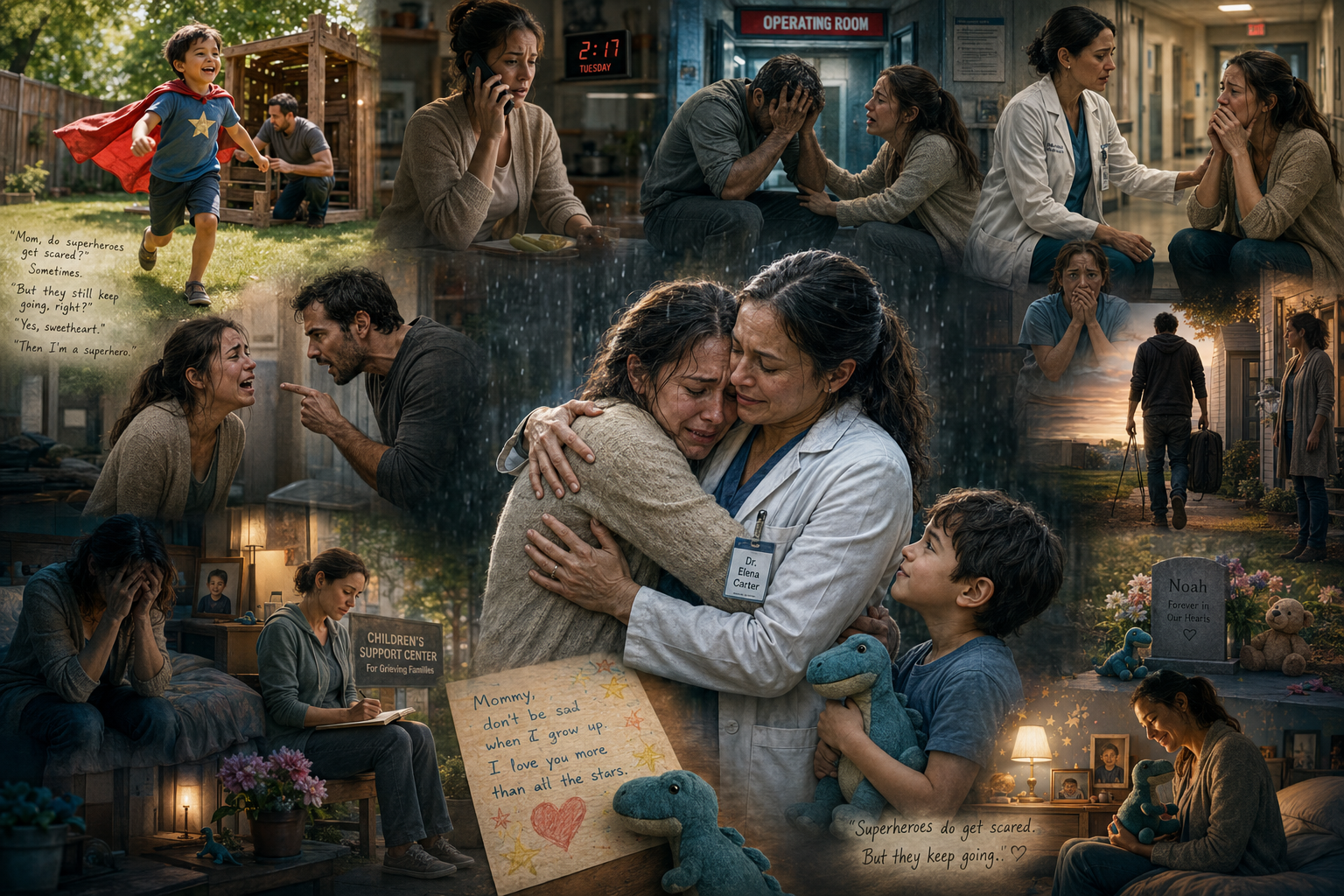
The phone call came at 2:17 on a Tuesday afternoon.
I remember the exact time because I had been standing in my kitchen, cutting apples for my five-year-old son, Noah.
He had been playing outside with his father that morning. They had built a little wooden fort in the backyard, and Noah had spent the entire morning running around it, pretending to be a superhero.
He was always moving.
Always laughing.
Always asking questions.
“Mom, do superheroes get scared?”
“Sometimes,” I had told him.
“But they still keep going, right?”
“Yes, sweetheart.”
He had smiled.
“Then I’m a superhero.”
Those were the last words I ever heard him say.
That afternoon, the hospital called.
There had been an accident.
Noah had fallen while playing.
At first, I didn’t understand how serious it was.
Children fall.
They scrape their knees. They bump their heads. They cry for five minutes and then ask for ice cream.
But this time was different.
When I arrived at the hospital, I saw my husband, Michael, sitting in the hallway with his head buried in his hands.
His shirt was covered in dirt.
His face was completely pale.
I ran toward him.
“Where’s Noah?”
He looked at me.
“He’s in surgery.”
My knees almost gave out.
“What happened?”
Michael stood up.
“He fell.”
“From where?”
“The fort.”
“How?”
“I don’t know.”
I grabbed his arm.
“Is he going to be okay?”
He didn’t answer.
That silence told me more than words could.
For the next three hours, I sat outside the operating room.
I prayed.
I begged.
I promised God anything.
Take my house.
Take my money.
Take my future.
Just give me my little boy back.
At one point, a doctor came out.
She was a woman in her forties with tired eyes and silver streaks in her dark hair.
She looked at me.
“Are you Noah’s mother?”
I stood immediately.
“Yes.”
She gently touched my shoulder.
“My name is Dr. Elena Carter.”
I looked at her face, desperately searching for hope.
“How is my son?”
She hesitated.
“We’re doing everything we can.”
That sentence broke something inside me.
I collapsed into the chair.
“No,” I whispered. “No, you have to save him.”
Dr. Carter sat beside me.
She didn’t tell me everything would be okay.
She didn’t make promises she couldn’t keep.
She simply took my hand.
And she stayed.
For nearly twenty minutes, she held my hand while I cried.
Then the operating room doors opened.
A nurse came out.
She was crying.
I knew.
Before anyone said a word, I knew.
Noah was gone.
My five-year-old son was gone.
The world continued moving around me, but mine had stopped.
I screamed.
I don’t remember everything I said.
I remember saying his name.
Over and over.
“Noah! Noah! My baby!”
Michael stood several feet away.
He wasn’t crying.
He was staring at the floor.
Then, suddenly, he looked at me.
“This is your fault.”
I froze.
“What?”
“You should have been watching him.”
“I wasn’t there.”
“You’re his mother!”
“I was at home!”
“You should have known something like this would happen!”
His words cut through me.
I couldn’t believe what I was hearing.
Our child had just died.
And my husband was blaming me.
That night, Michael left the hospital.
He didn’t come back.
Three days later, he packed his things and left our house.
He didn’t say goodbye.
He didn’t ask how I was doing.
He didn’t even attend the small memorial service we held for Noah.
I became a ghost.
I stopped answering calls.
I stopped cooking.
I stopped opening the curtains.
Noah’s shoes remained beside the front door.
His favorite blue jacket stayed hanging on the chair.
His toy dinosaur remained on his pillow.
Sometimes I would walk into his room and forget for half a second.
Then reality would hit me again.
And I would collapse.
People told me time would heal me.
I hated hearing that.
Time doesn’t heal everything.
Sometimes time simply teaches you how to carry the wound.
For months, I barely survived.
Then I remembered Dr. Carter.
Hang on.
Those were her words.
Don’t let the pain win.
I started with one day.
Then another.
I went to grief counseling.
I began walking every morning.
I planted flowers in Noah’s memory.
Slowly, painfully, I began living again.
Not because I stopped loving my son.
Because I realized surviving didn’t mean leaving him behind.
It meant carrying him with me.
Two years passed.
I had started volunteering at a children’s support center for grieving families.
One rainy afternoon, I was leaving the building when I heard someone call my name.
“Sarah?”
I turned.
And there she was.
Dr. Elena Carter.
For a moment, neither of us spoke.
Then she smiled.
I immediately walked toward her.
“I’ve wanted to find you,” I said.
She looked surprised.
“Why?”
“Because you held my hand when I thought my world had ended.”
Her eyes became glassy.
“I remember you.”
I laughed through my tears.
“I’ve thought about you for two years.”
Then I stepped closer.
“I wanted to hug you.”
She opened her arms.
I walked toward her.
But before I could reach her, I noticed something.
A small boy was standing beside her.
He was about six years old.
He had dark hair.
And he was holding a tiny blue dinosaur.
My blood ran cold.
I looked at the toy.
It was exactly like the dinosaur Noah used to carry everywhere.
Dr. Carter noticed my expression.
“This is my grandson, Daniel.”
The boy looked at me.
Then he smiled.
“Are you the lady Grandma helped at the hospital?”
I couldn’t speak.
Dr. Carter gently touched my arm.
“I’ve wanted to tell you something for a long time.”
“What?”
She took a deep breath.
“Your son wasn’t alone.”
I stared at her.
“What do you mean?”
“When Noah was brought in, we found a small note in his pocket.”
My heart stopped.
“A note?”
Dr. Carter nodded.
“It was written in crayon.”
She reached into her purse and pulled out a small envelope.
“I kept a copy because I knew someday you might need to see it.”
My hands trembled as I opened it.
Inside was a photograph of the note.
The handwriting was unmistakably Noah’s.
The words were simple.
“Mommy, don’t be sad when I grow up. I love you more than all the stars.”
I couldn’t breathe.
I pressed the paper against my chest and cried.
For two years, I had believed the last thing I had heard from my son was a question about superheroes.
But he had left me one final message.
And somehow, Dr. Carter had helped me find it.
I looked at her.
“Why did you keep this?”
She smiled through her tears.
“Because sometimes doctors save lives.”
She paused.
“And sometimes we simply help people survive the life they have left.”
I hugged her.
This time, neither of us let go quickly.
That evening, I went home and opened Noah’s bedroom door.
For the first time in two years, I didn’t collapse.
I sat on his bed.
I looked at his photographs.
And I whispered:
“I miss you, buddy.”
Then I smiled.
“You were right.”
I touched the little blue dinosaur sitting on his shelf.
“Superheroes do get scared.”
I wiped away my tears.
“But they keep going.”
That night, I finally understood what Dr. Carter had meant.
The goal was never to forget Noah.
The goal was never to stop hurting.
The goal was to keep loving him without allowing the pain to destroy the rest of my life.
My husband had left me believing I was responsible for our son’s death.
But I finally stopped carrying his blame.
I couldn’t change what happened that day.
I couldn’t bring Noah back.
But I could choose what happened next.
So I kept going.
For myself.
For Noah.
And for every grieving mother who thinks the darkness will last forever.
Because sometimes surviving isn’t a sign that you’ve forgotten the person you lost.
Sometimes surviving is the most powerful way of proving that their love is still alive.