
Three days after my father’s funeral, my stepmother walked into my house wearing that smile—the one that always meant she wanted something.
She didn’t say hello.
She didn’t ask how I was doing.
Instead, her eyes immediately went to the battered red toolbox sitting beside my front door.
It was old, scratched, and covered in years of grease and dust.
To anyone else, it probably looked like a worthless piece of junk.
To me, it was the only thing my father had left me.
“Give it to me,” April said.
I frowned. “What?”
“I’ll pay you $5,000 to throw it away.”
She pulled a thick stack of cash from her purse and placed it on my kitchen table.
I stared at the money.
Then I looked at her.
“Five thousand dollars?” I asked. “For a toolbox?”
April forced a smile.
“Your father was sentimental about useless things. That box isn’t worth anything.”
But something about the way she said it didn’t feel right.
My father had been a mechanic for nearly forty years. He could repair almost anything, and that toolbox had followed him everywhere.
I remembered being a little girl and sitting on the garage floor while he worked.
Sometimes I would hand him a screwdriver.
Sometimes I would just watch.
He used to laugh and say, “A good tool is worth keeping because you never know when you’ll need it.”
After he died, I asked for only one thing.
The toolbox.
April had laughed when she heard.
“You can have that old junk,” she said. “I don’t want it.”
Now, three days later, she was offering me $5,000 to get rid of it.
I pushed the money back toward her.
“No.”
Her expression changed.
“Think carefully.”
“I already have.”
She stared at the toolbox for several seconds.
Then she looked at me.
“You don’t know what you’re doing.”
She turned and walked out.
I stood there watching her leave.
And for the first time since my father’s funeral, I felt something other than grief.
I felt suspicious.
I carried the toolbox into my bedroom and locked the door.
Then I tried to open it.
The small metal lock wouldn’t move.
I searched through my father’s old belongings for a key.
Nothing.
I checked his garage.
Nothing.
I searched the drawers in his workshop.
Still nothing.
Then I remembered something my father had once told me.
“If you ever need the key, don’t look where you think it should be.”
At the time, I thought he was joking.
That night, I called my father’s younger brother, Uncle Mike.
“Did Dad ever tell you about a key to his toolbox?”
There was a long silence.
“Why are you asking?”
I told him about April.
I told him about the $5,000.
His voice immediately changed.
“Don’t give her that toolbox.”
My stomach tightened.
“Why?”
“Because your father was afraid of her.”
I sat down.
“What do you mean?”
Uncle Mike told me that several months before Dad died, my father had called him late one night.
Dad sounded frightened.
He told Uncle Mike that April had been pressuring him to change his will.
She wanted the house.
His retirement accounts.
His investments.
Everything.
“Did he tell you why?” I asked.
Uncle Mike sighed.
“He said he’d discovered something about her. Something involving money.”
I barely slept that night.
The next morning, I went through my father’s photographs, paperwork, drawers, and old boxes.
Nothing.
Then I thought about April.
If my father had hidden the key somewhere she wouldn’t look, maybe he had chosen a place she considered completely harmless.
I remembered her jewelry box.
She kept everything valuable inside it.
Not just jewelry.
Important documents.
Old photographs.
Keys.
Things she didn’t want anyone else touching.
Later that afternoon, I went to her house.
She opened the door.
When she saw me, her face immediately became tense.
“What do you want?”
“The key to Dad’s toolbox.”
Her face went pale.
“I don’t know anything about a key.”
“You just offered me $5,000 for the toolbox.”
“Because it’s junk.”
“Then why are you afraid of it?”
She slammed the door.
I stood there for a moment.
Through the window, I could see her jewelry box sitting on a small table.
I knew I shouldn’t do what I was thinking about doing.
But I needed answers.
Later, when she was gone, I found the key.
It was inside the jewelry box.
I took it.
My hands were shaking when I drove home.
I locked every door.
Then I placed the toolbox on my bed.
The key fit perfectly.
Click.
The lock opened.
At first, I saw exactly what I expected.
Screwdrivers.
Wrenches.
Pliers.
Old sockets.
Pieces of equipment my father had used for decades.
I almost laughed.
Maybe I had imagined everything.
Maybe April really had just wanted the toolbox for some sentimental reason.
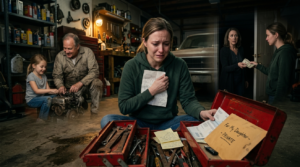
Then I lifted the bottom tray.
Something was underneath it.
A thin metal panel.
I removed it.
Beneath the panel was a small plastic-wrapped package.
My heart started pounding.
Inside was a USB drive, several handwritten notes, and a sealed envelope.
My name was written across the front.
“For my daughter.”
I sat on the edge of the bed.
Then I opened it.
The letter began:
“If you’re reading this, I’m probably gone.
And if April tried to take this toolbox from you, then she knows I found out.”
I stopped breathing.
I continued reading.
“I discovered that April has been taking money from our joint accounts.
At first, I thought it was an accident.
Then I found transfers to another account under a different name.”
My hands began to tremble.
The pages contained bank account numbers, dates, transactions, and handwritten calculations.
Over several years, hundreds of thousands of dollars had disappeared.
My father had documented everything.
But then I found something even worse.
April hadn’t simply been taking money.
She had been trying to make it look like my father was financially irresponsible.
She had opened credit accounts using his information.
She had transferred money into accounts he didn’t control.
And she had been preparing to sell the family home after his death.
My father’s letter continued:
“I don’t know how much time I have left.
The doctors keep telling me to rest, but I don’t trust April anymore.
If something happens to me, don’t confront her until you have proof.”
I looked at the USB drive.
It contained photographs, scanned documents, bank records, and audio recordings.
There was one recording dated six weeks before my father’s death.
I pressed play.
My father’s voice filled the room.
“April, I know what you’ve been doing.”
Then I heard her voice.
“You don’t understand.”
“I understand perfectly.”
“You were never supposed to find out.”
My blood ran cold.
My father confronted her about the missing money.
April admitted taking it.
Then she said something that made me cover my mouth.
“I did it because I knew you were going to leave everything to her.”
My father replied:
“She’s my daughter.”
April’s voice became bitter.
“She’s going to get everything while I get nothing.”
My father’s voice rose.
“You married me because you loved me, not because you wanted my money.”
April laughed.
“You really believe that?”
I stopped the recording.
I couldn’t listen anymore.
My father had known.
He had known the woman beside him wasn’t who she pretended to be.
And he had tried to protect me.
But there was one more document inside the toolbox.
A copy of his updated will.
Almost everything had been left to me.
The house.
His savings.
His workshop.
His investments.
April had been left a small amount of money and the right to remain in the house for six months.
But there was another clause.
If April attempted to take, hide, or destroy his personal property, the inheritance would be transferred into a trust for me.
Suddenly, everything made sense.
The $5,000.
The urgency.
The fear in April’s eyes.
She wasn’t trying to buy a toolbox.
She was trying to destroy the evidence inside it.
I contacted an attorney and gave him everything.
The bank records were verified.
The recordings were authenticated.
The financial transfers were real.
Within weeks, investigators became involved.
When April was confronted with the evidence, she finally admitted what she had done.
She had believed that after my father’s death, everything would disappear with him.
She never expected him to leave behind proof.
But he had.
Hidden inside the old toolbox she thought was worthless.
Months later, I stood in my father’s garage for the first time since his funeral.
Everything was quiet.
I opened the toolbox and ran my hand across the worn metal.
For a moment, I could almost hear my father’s voice.
“A good tool is worth keeping because you never know when you’ll need it.”
Finally, I understood what he meant.
The toolbox wasn’t valuable because of the tools inside.
It was valuable because my father had trusted me to find the truth.
He knew that one day I might need more than a wrench or screwdriver.
I might need the truth he had hidden there.
April had offered me $5,000 because she thought she could buy my silence without me even knowing what I was selling.
She was wrong.
That battered toolbox was worth far more than $5,000.
It contained my father’s final words.
His protection.
His evidence.
And the truth about the woman who had tried to take everything from him.
But the most valuable thing it gave me wasn’t money.
It was peace.
For months after my father’s death, I had wondered whether I had done enough for him.
Whether I had called him often enough.
Whether I should have noticed how unhappy he had become.
Whether I could have saved him from the person he trusted.
Standing in that garage, I finally realized something.
My father had already saved himself.
And in the end, he had saved me too.
Sometimes the things people dismiss as worthless are the very things that carry the greatest value.
Sometimes a battered old toolbox isn’t just a box of tools.
Sometimes it’s a message from someone who loved you enough to prepare for the truth—even after they were gone.
And sometimes the person offering you thousands of dollars to throw something away is the very person who is most afraid of what you’ll find inside.