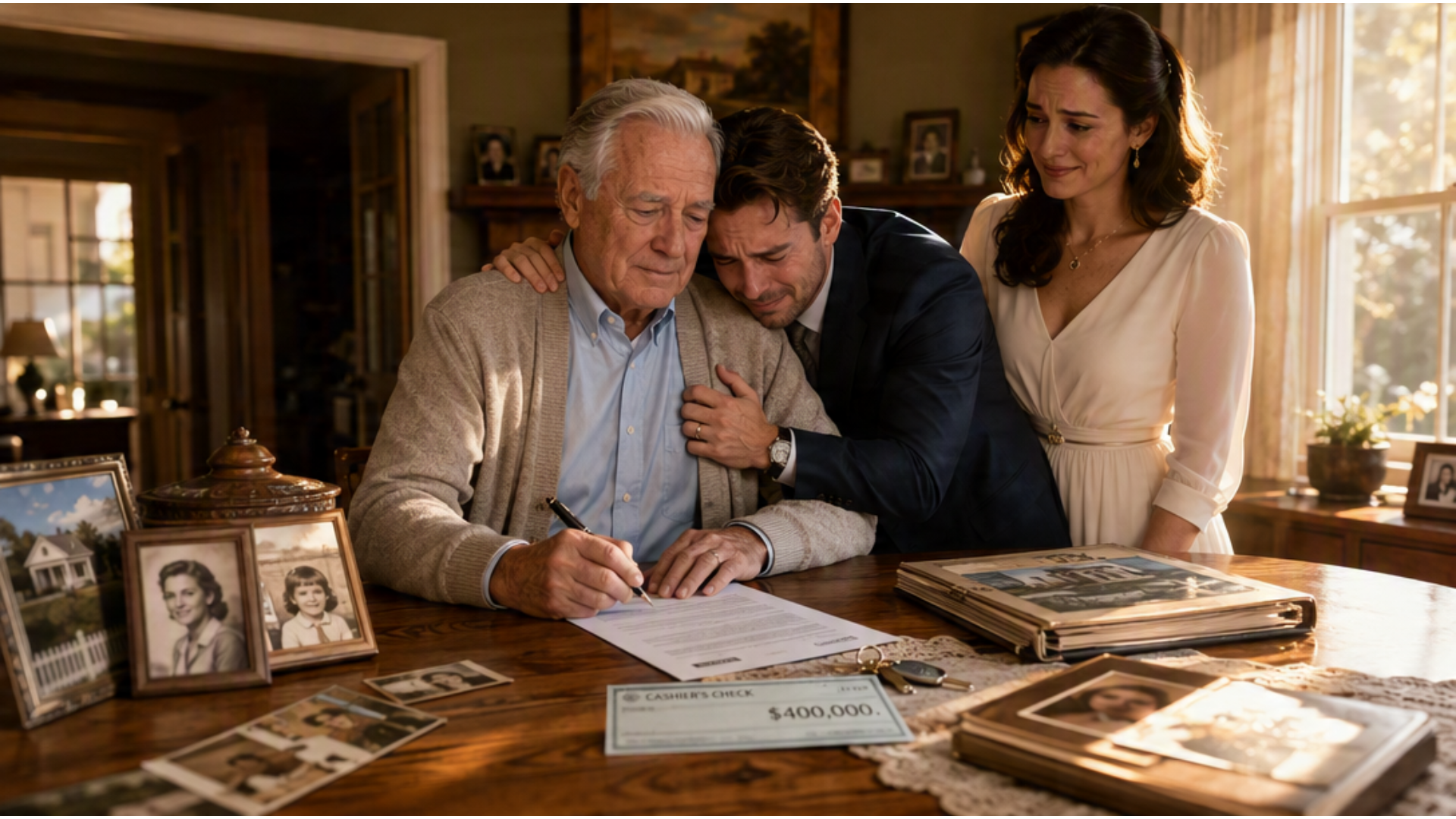

The day I handed my son a cashier’s check for four hundred thousand dollars, I thought I was giving him a future.
I didn’t realize I was signing away my own.
For forty years, my little white farmhouse had been more than a house. It was where my late wife, Helen, and I raised our only child, Michael. We celebrated birthdays beneath the old oak tree in the backyard, carved pumpkins every October on the front porch, and watched countless sunsets from the swing I built with my own hands.
Every room held a memory.
Every wall echoed laughter that still lived in my heart.
After Helen passed away from breast cancer, the house became quieter, but it was still home. I could almost hear her humming while she cooked dinner or calling my name from the garden.
Then Michael came to me with a dream.
“Dad,” he said, spreading blueprints across my kitchen table, “I’ve developed software that could change how hospitals manage patient records. Investors love the idea, but they want me to have more capital before they’ll commit.”
“How much do you need?”
He hesitated.
“Around four hundred thousand.”
I nearly laughed.
It was more money than I’d ever imagined spending at once.
“I know it’s impossible,” he said quickly. “Forget I asked.”
But I couldn’t.
He was my son.
I’d watched him stay up late studying, graduate with honors, and work tirelessly for years. If anyone deserved a chance, it was him.
Two months later, I sold the farmhouse.
The day I handed him the check, his eyes filled with tears.
“Dad… I don’t know how I’ll ever repay you.”
I smiled.
“You already have.”
He hugged me so tightly I could barely breathe.
“I promise,” he whispered. “You’ll never regret this.”
I believed him.
Without the house, I moved into the guest bedroom of Michael’s modern suburban home. His wife, Sarah, welcomed me politely enough.
“We’re happy to have you,” she said.
At least, that’s what she said.
The first few months weren’t bad. I tried to earn my keep. Every morning I made breakfast before they woke up. I packed Michael’s lunch just like I had when he was in school. I mowed the lawn, folded laundry, cleaned the kitchen, and picked up groceries whenever I could.
I didn’t want to be a burden.
If anything, I wanted them to forget I was there.
Whenever they hosted dinner parties, I quietly ate upstairs. If their friends came over, I stayed in my room watching old western movies or reading novels Helen had loved.
Sometimes I heard laughter drifting up the stairs.
I smiled anyway.
They were young.
They deserved their privacy.
As Michael’s company grew, so did the distance between us.
He became busier.
Phone calls replaced conversations.
Quick nods replaced hugs.
Some evenings, he’d walk past me without even realizing I was sitting in the living room.
I told myself it was temporary.
Success demanded sacrifice.
One afternoon I overheard Sarah talking on the phone.
“I don’t know how much longer this can continue,” she sighed. “The guest room would make the perfect office.”
My heart sank.
I tried to ignore it.
A week later, Michael knocked on my bedroom door.
He didn’t sit down.
He didn’t even come inside.
“Dad,” he began awkwardly, “Sarah and I have been talking.”
I already knew what was coming.
“We found a really nice retirement community about twenty minutes away.”
I stared at him.
“What?”
“They have activities, nurses, transportation… you’d love it.”
“I never asked to leave.”
He rubbed the back of his neck.
“We just think it’s time.”
The words hit harder than any punch.
“I sold my home,” I whispered.
“I know.”
“So you could build your company.”
“I know.”
“I moved here because you asked me to.”
“I know, Dad.”
His voice remained calm.
Almost rehearsed.
Sarah stepped into the hallway behind him.
“We’re really trying to do what’s best for everyone.”
Everyone.
Apparently, I wasn’t included in that word anymore.
Then Michael glanced toward the dining room.
“Oh, one more thing.”
I looked up.
“We’re replacing your old oak dining table.”
“The one your mother and I bought?”
“Yeah.”
“It’s antique.”
“I know.”
“We already found a buyer.”
For a moment, I couldn’t speak.
That table wasn’t just furniture.
Helen had baked birthday cakes on it.
Michael had done homework there.
We’d celebrated every Christmas around it.
It was the last piece of our old home.
“You sold it?”
Michael nodded.
“The buyers pick it up Friday.”
That night, I sat alone beside the table, running my fingers across every scratch and every worn edge.
Each mark told a story.
A spilled glass of apple juice from Michael’s fifth birthday.
A tiny burn from Helen’s favorite candle.
The faint pencil line where we’d measured Michael’s height every birthday until he turned eighteen.
I whispered into the silence.
“I’m sorry, Helen.”
Three days later, Michael announced exciting news.
“Dad, we’ve got the biggest investors in California coming over Saturday night.”
“Really?”

“They’re considering putting ten million dollars into the company.”
I smiled despite everything.
“That’s wonderful.”
He hesitated.
“We’ll need the house quiet.”
I nodded.
“I understand.”
He looked relieved.
“I appreciate it.”
Saturday evening arrived.
Luxury cars filled the driveway.
Elegant guests laughed as they entered carrying expensive bottles of wine.
I watched from upstairs through the bedroom window.
Then I heard Sarah’s voice.
“Just make sure your dad stays upstairs.”
Everyone laughed.
Including Michael.
I quietly closed the curtain.
For the first time in my life…
I cried because of my son.
For nearly an hour, I sat alone in the guest room while laughter echoed from downstairs.
Every now and then I caught pieces of conversation drifting through the vents.
“…fastest-growing healthcare startup…”
“…remarkable leadership…”
“…ten-million-dollar investment…”
I smiled despite the ache in my chest.
No matter how hurt I felt, I still wanted Michael to succeed.
He was my son.
At exactly seven-thirty, I heard glasses clink together.
Dinner had begun.
I looked toward the closet.
On the top shelf sat an old brown leather briefcase.
I hadn’t opened it in years.
Inside was a neatly organized manila folder.
My attorney, Richard Lawson, had insisted I keep it.
“Frank,” he had said when I sold my house, “love your son all you want, but never give away your life’s savings without protection.”
At the time, I thought he was being overly cautious.
Now I understood why.
I picked up the folder and slowly walked downstairs.
The room fell silent the moment I entered.
Eight sharply dressed investors turned toward me.
Michael’s smile disappeared.
“Dad,” he said through gritted teeth. “I thought you were staying upstairs.”
“I was.”
Sarah stood up quickly.
“We’re in the middle of an important meeting.”
“I know.”
One of the investors smiled politely.
“You must be Michael’s father.”
I nodded.
“I am.”
Michael forced a nervous laugh.
“My dad gets confused sometimes.”
The words stung more than I expected.
“I’m not confused,” I replied calmly.
I walked to the dining table.
My dining table.
The same solid oak table where my late wife had once taught Michael how to bake cookies.
I gently placed the manila folder in the center.
“I brought something that belongs to everyone here.”
Michael’s face turned pale.
“Dad…what are you doing?”
“I think these fine people deserve to know exactly how your company began.”
One investor leaned forward.
“What do you mean?”
I opened the folder.
Inside were copies of legal documents, bank records, and one signed agreement.
“My late wife and I spent forty years building our savings,” I said quietly. “When my son needed capital, I sold my home and invested four hundred thousand dollars into his company.”
The investors exchanged surprised looks.
Michael interrupted.
“It wasn’t an investment.”
“It was a gift.”
I looked directly at him.
“That’s not what your signature says.”
Silence filled the room.
I handed the first document to the lead investor.
Four years earlier, my attorney had drafted a simple agreement before releasing the money.
At Richard’s insistence, Michael had signed it without reading much beyond the first page.
He trusted me.
And I trusted him.
The document clearly stated that if the company reached outside investment or was sold, my initial contribution would automatically convert into a fifteen-percent ownership stake unless I voluntarily declined it.
The lead investor slowly read every page.
Then another.
Finally, he looked up.
“Mr. Harrison…is this authentic?”
“It is.”
Michael’s face had turned completely white.
“Dad…I thought—”
“You thought it was just paperwork.”
He couldn’t answer.
Sarah reached for the documents.
The investor stopped her.
“I’ll hold onto these.”
The room remained painfully quiet.
Then one of the investors spoke.
“Michael…why weren’t we informed that another shareholder existed?”
Michael swallowed hard.
“I…I forgot.”
Another investor frowned.
“You forgot the person who funded the entire company?”
No one believed him.
The lead investor folded the agreement carefully.
“Transparency matters to us.”
He turned toward me.
“Sir, did you know your son planned to move you out of the house?”
I hesitated.
“There isn’t room for me anymore.”
The investors glanced around the elegant dining room.
One elderly investor quietly asked, “Is this your dining table?”
“It was.”
“He was selling it Monday,” I admitted.
No one spoke.
The silence was louder than any argument.
Finally, the lead investor closed the folder.
“I think we should postpone tonight’s decision.”
Michael stood abruptly.
“Wait…please…”
The investor raised a hand.
“A business built on innovation can recover from mistakes.”
He paused.
“A business built on dishonesty rarely does.”
One by one, the investors stood, shook my hand, and quietly left the house.
The front door closed.
Michael stared at the empty driveway.
Ten million dollars had disappeared in less than five minutes.
He slowly turned toward me.
“I never meant for this to happen.”
I looked at my son—not the successful CEO standing before me, but the little boy who used to run into my arms after school.
“When your mother was dying,” I said softly, “she asked me to promise one thing.”
His eyes filled with tears.
“She said, ‘Make sure Michael grows into a good man. Success means nothing without kindness.'”
He covered his face.
“I’m sorry.”
“For what?”
“For everything.”
“The money?”
“No.”
“The house?”
He shook his head.
“For forgetting the people who loved me before anyone believed in me.”
For several moments, neither of us spoke.
Then Sarah stepped forward.
She was crying too.
“I owe you an apology,” she whispered. “I saw you as someone taking up space instead of someone who gave us everything.”
I nodded.
“Thank you for saying that.”
The following week, something unexpected happened.
Michael canceled the sale of the dining table.
He converted the largest room in the house into a comfortable first-floor suite just for me.
More importantly, he stepped down as CEO for several months and hired experienced executives to help rebuild trust with the investors.
It wasn’t easy.
Some investors never returned.
Others eventually did—but only after Michael personally admitted his mistakes and updated every legal document to reflect my ownership fairly.
A year later, the company finally secured new funding.
Not because of brilliant software.
Not because of impressive presentations.
But because the investors believed a man who could admit his failures had learned how to lead with integrity.
One Sunday afternoon, Michael carried two cups of coffee onto the back porch.
“Dad?”
“Yes?”
“Do you know what my biggest investment turned out to be?”
“The company?”
He smiled.
“No.”
“You.”
I laughed.
“I almost lost the best thing I ever had because I was chasing something I thought mattered more.”
I looked toward the old oak dining table through the window.
It still stood in the same place.
Scarred.
Weathered.
Beautiful.
Just like our family.
Some cracks can never completely disappear.
But with honesty, forgiveness, and love, they become reminders—not of what nearly broke us, but of what we chose to rebuild together.
And every Thanksgiving since then, our family gathers around that same oak table.
The grandchildren know every scratch has a story.
When they ask why Grandpa smiles every time he touches its worn surface, I simply tell them the truth.
“Because this table reminds me that fortunes can be earned, businesses can be rebuilt, but a family is only truly rich when its members never forget the sacrifices that love has already made.”